MoveSpring | 2021
B2B2C SaaS
Product Design
Product Strategy
UI Design

Project at a glance
ROLE
Lead Designer
TEAM
Head of Product Design, Engineering
TIMELINE
~3 weeks
Impact
Shifted MoveSpring from a fitness-tracking platform to an inclusive wellness platform, unlocking a new category of challenges beyond movement and fitness
Adopted by clients to run programming around mindfulness, hydration, and sleep
Led to expanding activity logging beyond challenges a few months later, helping users build healthy habits independent of any competition
Shipped fast by building entirely on existing components, keeping pace with client demand
Opportunity
Create an inclusive wellness platform by building upon movement-based activities and challenges
Since day one, MoveSpring provided fun and approachable activity challenges to companies and organizations. But challenges were limited to movement-based metrics captured by wearable devices: steps, distance, active minutes.
As MoveSpring grew its base of annual subscription clients running ongoing wellness programs, demand grew for something more: the ability to track any activity, and compete on it. That demand was amplified by the pandemic, as clients looked for new ways to help employees build healthy habits while working from home.
Health is so much more than physical activity…it’s what you eat, how you manage stress, how well you sleep. Building custom activity tracking was an easy call: it aligned directly with MoveSpring’s mission to be an inclusive wellness platform.

Problem
So. How might we capture activities that aren’t automatically synced by wearable devices?
To date, MoveSpring pulled in data from a variety of fitness trackers and wearables. Steps, distance, and active minutes were our primary metrics, automatically synced when a user opened the MoveSpring app. All challenges were based of these metrics.
As I explored branching into custom activities, I had to solve for two things: how users would manually capture the completion of an activity, and if those new activities would fit into our existing challenge modes.
I set out to answer two questions:
How might we enable users to compete on non-movement based metrics?
How might we capture activities that weren’t automatically synced by wearables?
Approach
Adapting established challenge modes for a streamlined design solution
Introducing custom activities into a challenge-based context turned out to be a fast solve, thanks to groundwork already in place. I’d previously established a modular design system across all of MoveSpring’s challenge modes, and two existing challenge modes were already built around habitual, daily activity: Streak and Stick to It. I worked within the existing system to design new UI elements that could flex between device-tracked and custom activities. Engineering capacity was tight so it was the right call vs. inventing something new.
By replacing the usual progress chart with the custom activity’s name and completion status, I made both challenge modes fully compatible with any activity a client or user wanted to define. The rest of the component-driven design adapted on its own. Admins simply named their custom activity, picked a challenge mode, and the platform handled the rest.

Small differences in Streak challenges between movement-based and custom activities
Streak
Streak tracks consecutive days a user hits their goal, restarting if they miss a day. Participants try to see how long they can make their streak last and are ranked by length of streak.
Custom activity examples:
Taking a 5 minute break outside each day for 2 weeks.
Drink 8 glasses of water daily for 30 days.

Small differences in Stick to It challenges between movement-based and custom activities
Stick to It
Stick to It asks users to hit a daily goal a set number of times over a challenge. The focus is on consistent effort and progress toward creating healthy habits, not perfection.
Custom activity examples:
Meditate for 5 minutes 10 times over the next 14 days.
Eat a plant-based dinner 10 times over the next month.
One question remained…
How might we capture activities that aren’t automatically synced by wearables?
Up to this point, MoveSpring’s activity challenges were completely automated without requiring direct user input. With no wearable syncing this data automatically, how would users actually mark a custom activity as done?
Solution
A familiar, satisfying way to log completion: swipe to complete
I started exploring ways to complete a task…checkboxes…photo-based proof…but I didn’t need to invent a new interaction. I adapted “swipe to complete,” a pattern we’d introduced in an earlier feature. From multiple entry points in the app, users tap to log an activity, then swipe to complete from a focused bottom sheet. Small, satisfying, and already familiar to returning users.
Leaning on established patterns and components kept the design and engineering process fast, while opening up countless new ways for people to compete inside a challenge experience they already knew.
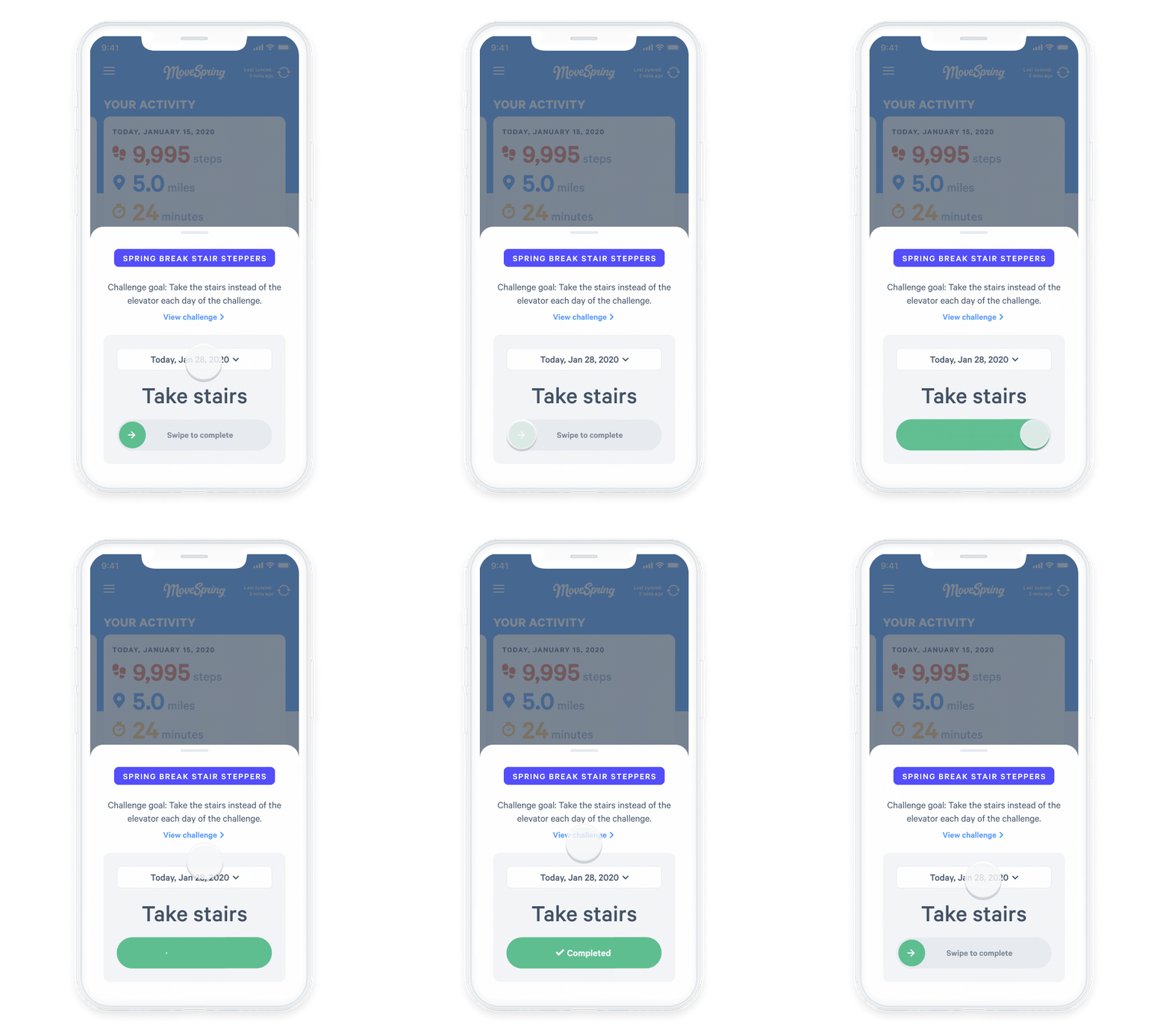

With our modular components, I easily adapted our movement-based challenges to accommodate custom activities

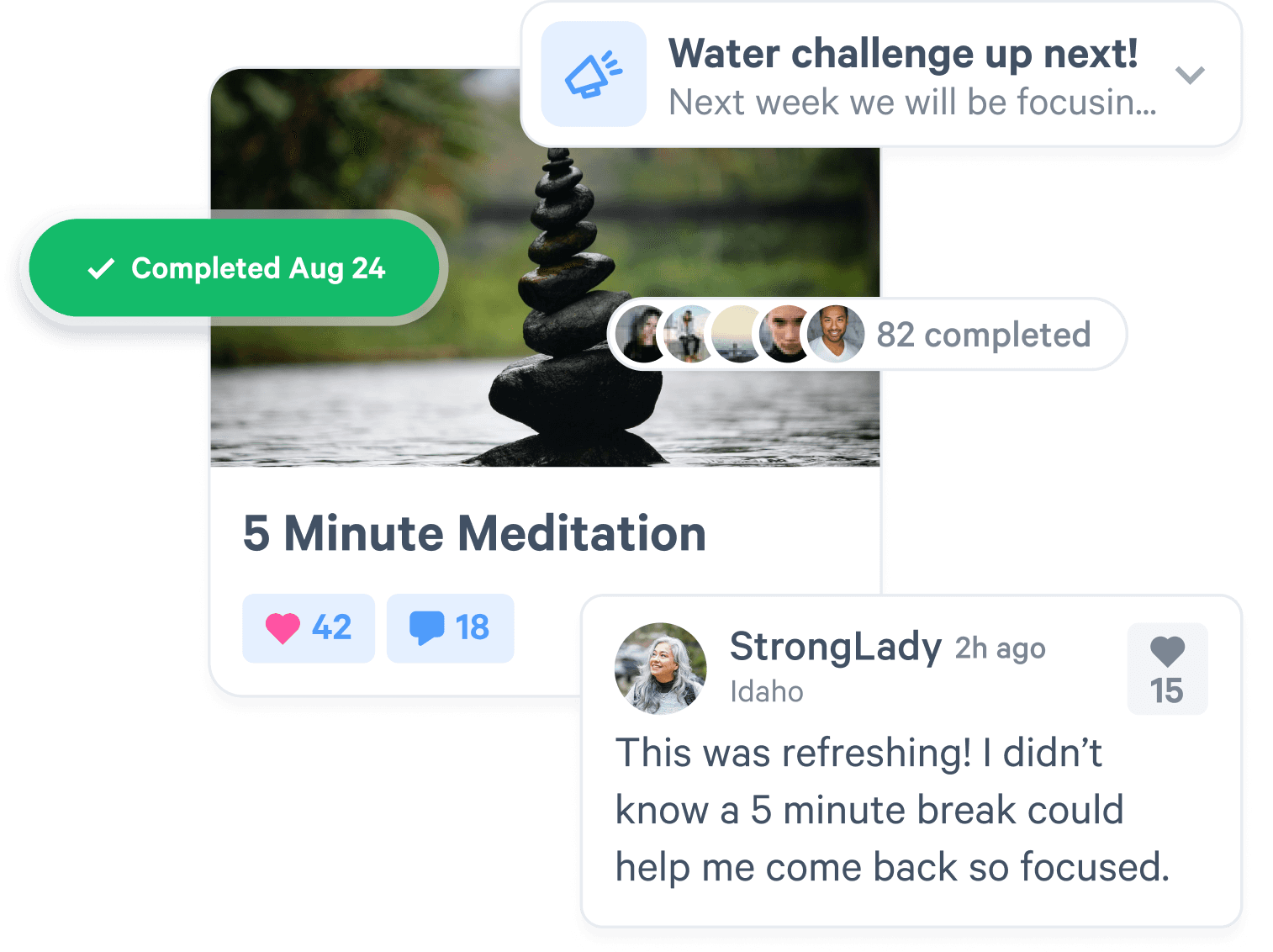
Custom Activity Challenge with a meditation focus and related in-app content
The result
Supporting wellness goals and healthy habits, not just activity goals and steps
Within a few weeks, clients were running challenges MoveSpring had never supported before: meditation streaks, hydration goals, sleep tracking. Paired with our Content module, Custom Activity Challenges became a new selling point—comprehensive wellness programming built for lasting habit change, not just activity tracking.
This shifted what MoveSpring’s community features were for. The same tools that once measured steps and distance now supported gratitude, stress management, and rest, meeting employees wherever they were in their wellness journey.
❤️
...and a little customer love...
Ciera G.
Admin at a mid-sized company
Taylor E.
Admin at a small company